 Applied Symbiotic Intelligence
Trust, proven at the source
The answer is usually already in what you have.
What’s missing is the seeing, and the proof that it holds. We find what connects across your evidence, then try to prove it wrong at the source before you rely on it.
Independent blind evaluations
Rival-lab AIs judged our analysis first in every one.
We were one of the answers being judged, never one of the judges.
See the record ↓The record
The comparison was blind. We were only ever one of the answers, never a judge.
The same question, answered several ways, with every mark of who produced what stripped away. Every judge was an independent AI model from a rival lab, and we designed the test to be hard on our own answer.
We are not telling you we always win. We designed and ran these comparisons ourselves, and our answer was the only one whose author was not also among the judges. Every judge here was an AI, some sharing a model family with the answers they scored, and none ranked its own kind first. What this shows is that our analysis was ranked first under each test, not that the science is settled: independent human review is the harder, cleaner test, and it is still ahead.
See the five evaluations, and why ours won
The five evaluations · de-identified
Why ours won · the three reasons the judges kept naming
We checked every source at its origin.
Others cited author and year with nothing to look up. Ours anchored each source to a verifiable identifier.
We tried to prove our own finding wrong.
We named the conditions that would break the claim, in the analysis itself.
We caught what others missed.
A miscited paper at the core of one argument, confirmed wrong at the source.
Watch the method run
One of the most cited papers in Alzheimer’s research.
It didn’t hold.
Nature retracted it in 2024.
The retraction is public. Our method checks every source at its origin, so a paper that no longer holds shows up in the review, not after it is already part of your trial, your paper, or your decision.
How we work
One move, run with discipline.
Read across the evidence.
Everything you have, read together, including the fields that rarely talk to each other.
Try to prove the finding wrong.
At its primary source, before anyone commits money, a team, or a year.
Trust only what survives.
What holds after the attempt to break it is what we put our name on.
A model checking its own work only agrees with itself, so every finding is checked by independent models, resolved at its source, and a domain expert decides.
Work with us
Two ways in.
Source Review · before you submit
Catch the one reference that doesn’t hold, before it is part of the record.
A pre-submission integrity review for high-stakes manuscripts. Every citation checked at its source; a person releases it.
See Source Review →Intelligence engagements · before you commit
Find the connection your specialists can’t see from inside one silo.
Surface what connects across the evidence, and show which findings survive, before a major decision.
Start a conversation →The methodology behind our reviews is patent-pending
If you see what we see, we’d like to hear from you.
A person reads every message. No list, no automation.
Who we are
A practice built around one discipline: proving whether an answer holds before you rely on it.
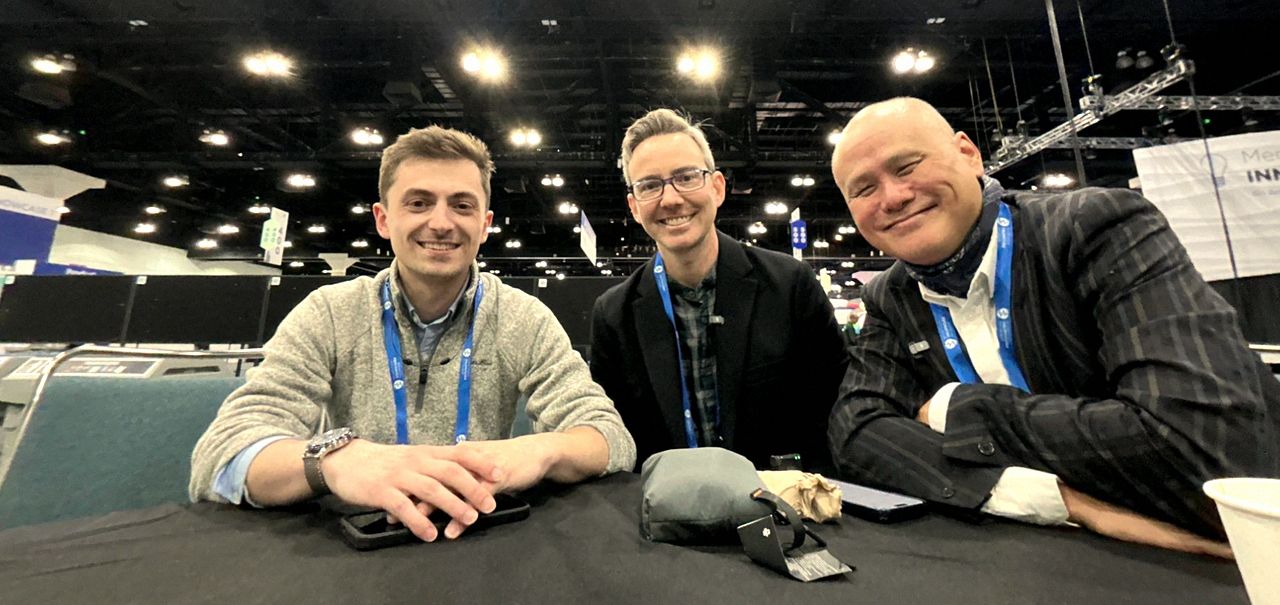
Founder & CEO
Twenty years directing and producing broadcast work, where the story has to hold up in public and ship on a deadline. He runs every engagement personally, and he is the person who reads your message.
Chief Technology Officer
An inventor with a granted US patent, trained at Berklee. He builds and hardens the systems that every review and every engagement runs on.
Chief Architect
Devin designed the knowledge architecture that makes cross-domain connections possible. Background in neuroscience, mechanical engineering, and systems design, Georgia Tech.
On the record